

Welcome to a new (Substack-only) series, “Art’s Open Door,” where we’ll explore the profound ways creativity and spirituality intersect, inviting us into a deeper sense of well-being, connection, and joy.
Listen to the horn melody at 32:14, or find space to be still and take in the whole masterpiece.
“Instructions for living a life.
Pay attention.
Be astonished.
Tell about it.”
― Mary Oliver
If Brahms lived, like us, in the days of internet browsers and word processors, he would have had the tab for his Symphony No. 1 open for 22 years. From early sketches to the work’s premiere, Brahms worked on one 50-minute piece of music for a whole third of his life.1
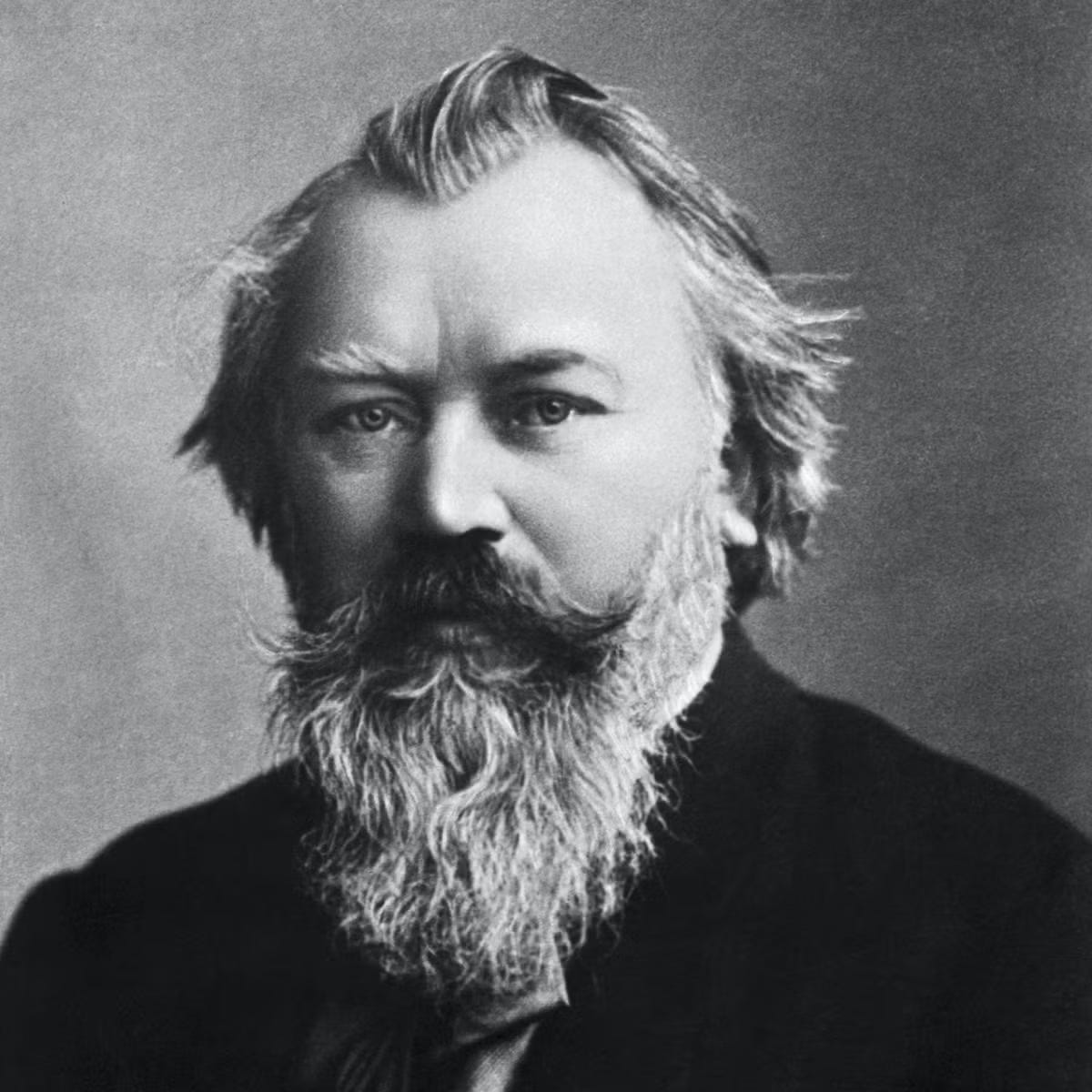
He suffered from what music historians called the Anxiety of Influence, which for Brahms meant constantly listening for the metaphorical footsteps of the symphonic giant, Beethoven, behind him. Early in his career, Robert Schumann, fellow composer and music critic, anointed Brahms as the Next Great Classical Innovator. After Haydn, Mozart, and Beethoven, Brahms would be the one to write the next great symphony. Beethoven’s 10th. No pressure, Johannes.
I imagine him at his piano with his round, bearded face in his hands, candlelight flickering, ashes from the pages he’d abandoned to the flames still floating in the air. He infamously set his music on fire before anyone could see it, destroying drafts and entire leather-bound scores. The manuscript of the first symphony is marked as “lost:” lost to the blaze of creative u-turns, the all-consuming conflagration of his fear, perfectionism, doubt, and perhaps a little vanity.
There is a time in every artist’s life when we become aware of what Ira Glass calls “The Gap.”2 The space between our taste—the vision of the thing we are making, the hope of what it could be—and the (often depressing) reality of what it is today. We get into creative work because we see this vision, we hear its call. And by some miracle, at the most random times, when we are reading a novel or loading the dishwasher, the light flashes, and all we can do is stand still and listen. We hear the sounds we want to make in our head; we know the feelings we want the story to evoke or how the finished painting should look. And we definitely know when the work we are making isn’t cutting it.
It isn’t that we are always too hard on ourselves (although sometimes we are). It’s more that we’ve heard a melody we cannot unhear—a flicker, a thread—resonant with some inner longing, and we hold onto it so desperately through the cacophony of life, willing it into being. We labor in service to something as nebulous as a feeling we had once while we were walking the dog. And even just a moment later, when it was once so bright and clear, the sound of that spiritual song becomes faint. We get stuck in the echo chamber of self-consciousness, hearing nothing but the recurring clangor of our own thoughts. Some days, that gap feels like an impenetrable ravine between us and completion. The many imperfections of the work taunt from down below; it’s too terrifying to step to the edge.
In short, I get why Brahms turned an early symphony draft into a piano concerto mid-stream. I get why he set his scores on fire.

Lately, my own creative process has felt like walking into a familiar room, only blindfolded. I sit down to a blinking cursor on a big project—my next book.3 It is something that will take me years to finish, something I feel, in some ways, I have been writing (and longing to write) all my life. It is finally time to make this thing, and amazingly, it is now my job to tend this seed and shepherd the work into the world. Cue fireworks and celebration emojis.
And yet, as I get down to work these days—the first three chapters are due to my editor soon—I can’t help but think of Brahms. While I don’t hear Beethoven’s footsteps behind me, I do sense a deeply judgmental inner mean girl waiting for my greatest fears to be confirmed. My original idea cowering in the corner like a small, scared animal, I have to fight the overwhelming impulse to crumple the metaphorical paper and throw it into the actual fire.
Last time I was in this war room of writing a book, I had the time and made the space every week to listen to what the book wanted to be. I gave myself a weekly deadline for Friday’s podcast, and the writing felt less like creating something out of nothing and more like getting out of the way. But that process wasn’t working this time. After weeks of wringing my hands and staring anxiously at a blank Word document—writing and deleting, writing and deleting—this was the message I received loud and clear: this book will not come through the same old channels.
Lest we forget: creative projects speak. And in a desire to name the document or feel productive or keep the death grip tight on what little control we think we have, we do not—I do not—always listen. In lieu of walking to the periphery of my abilities and standing along the edge of that abyss, I get busy, manic. The answers never come through more striving, and yet I strive still.
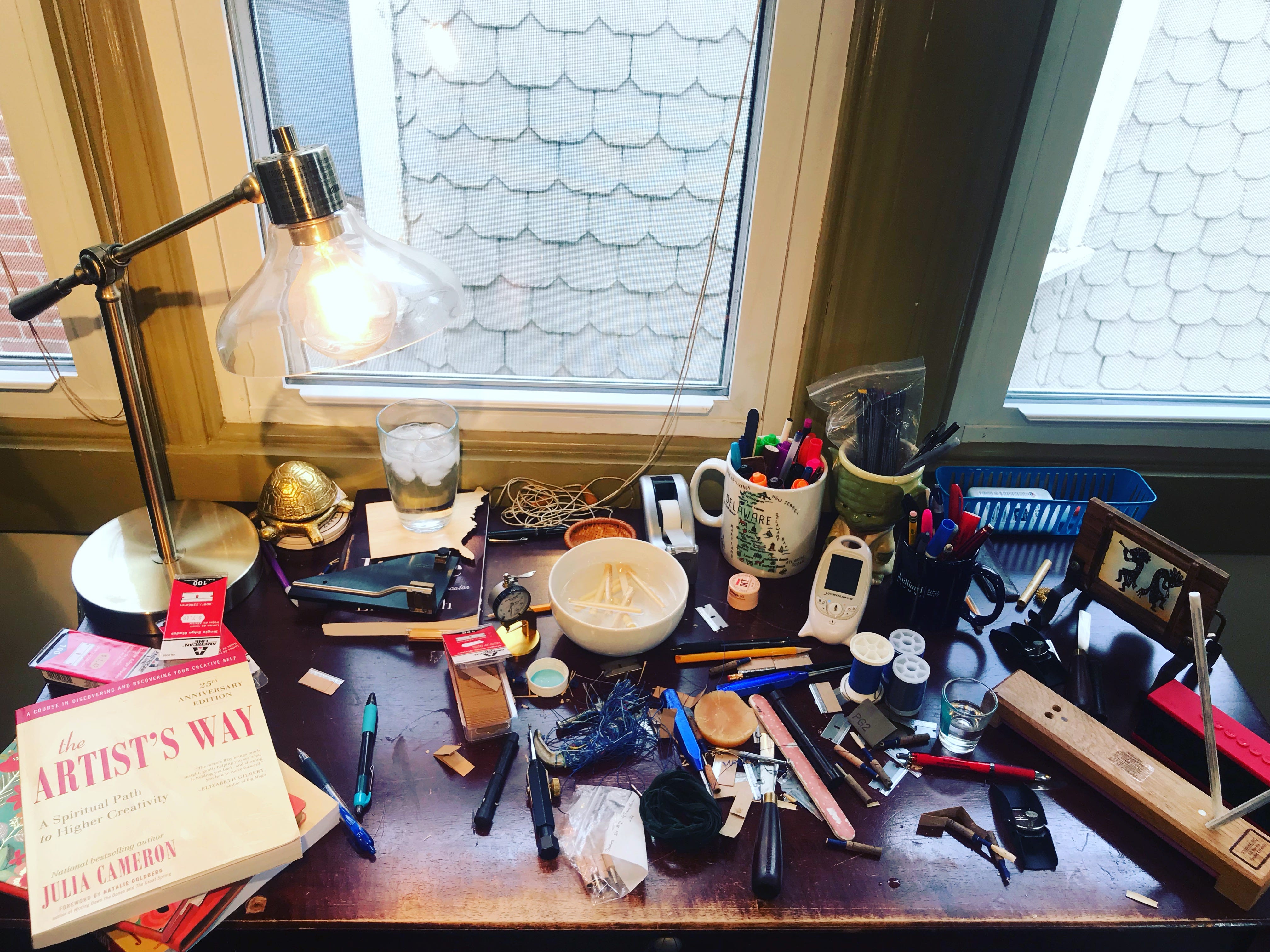
I knew an oboe teacher once who used to say to his students, “Don’t take ‘no’ for an answer from an inanimate object.” With sheer will, hard work, dedication, and more and more sacrifice, he implied, you (a living, breathing human being) can make the oboe and your reeds (inanimate objects) do what you want them to do. You are the one with the brain, so make those dead things work.
I can see what he was getting at, but now, years later, I think these sentiments put me at odds with my intuition, with the spiritual invitation of art-making. It is deep work, listening to the materials in your hands. While they aren’t “living” in an earthly sense, when the cane becomes a reed or the words become a poem, they are brought to a kind of life. And that life sometimes has a will of its own. Even a beginner potter can feel the energy from a mound of clay.
I’m not sure who else could do that—could perform such alchemy—besides God. Dry bones live. Lines leap like a ballerina off the page. God can speak through everyday “inanimate” objects, can use these humble materials to call us artists to some deeper purpose.
Bossing the materials around might work for a while, but it puts striving in the seat of the ultimate way-maker.
My new book made it very clear this week: my usual try-hard perfectionist mindset, creating from a place of striving—she has no power here. This is not something I can bend to my will by sheer force. Instead, it requires a profound and uneasy soul-deep stillness. It calls me into murky, opaque waters, where I surrender my complete and total attention.
And there I stand, teetering on the edge, arms up, ready to fight.
If creativity is a spiritual practice, if art is an open door to something beyond us, then why does it sometimes feel so much like a battlefield?
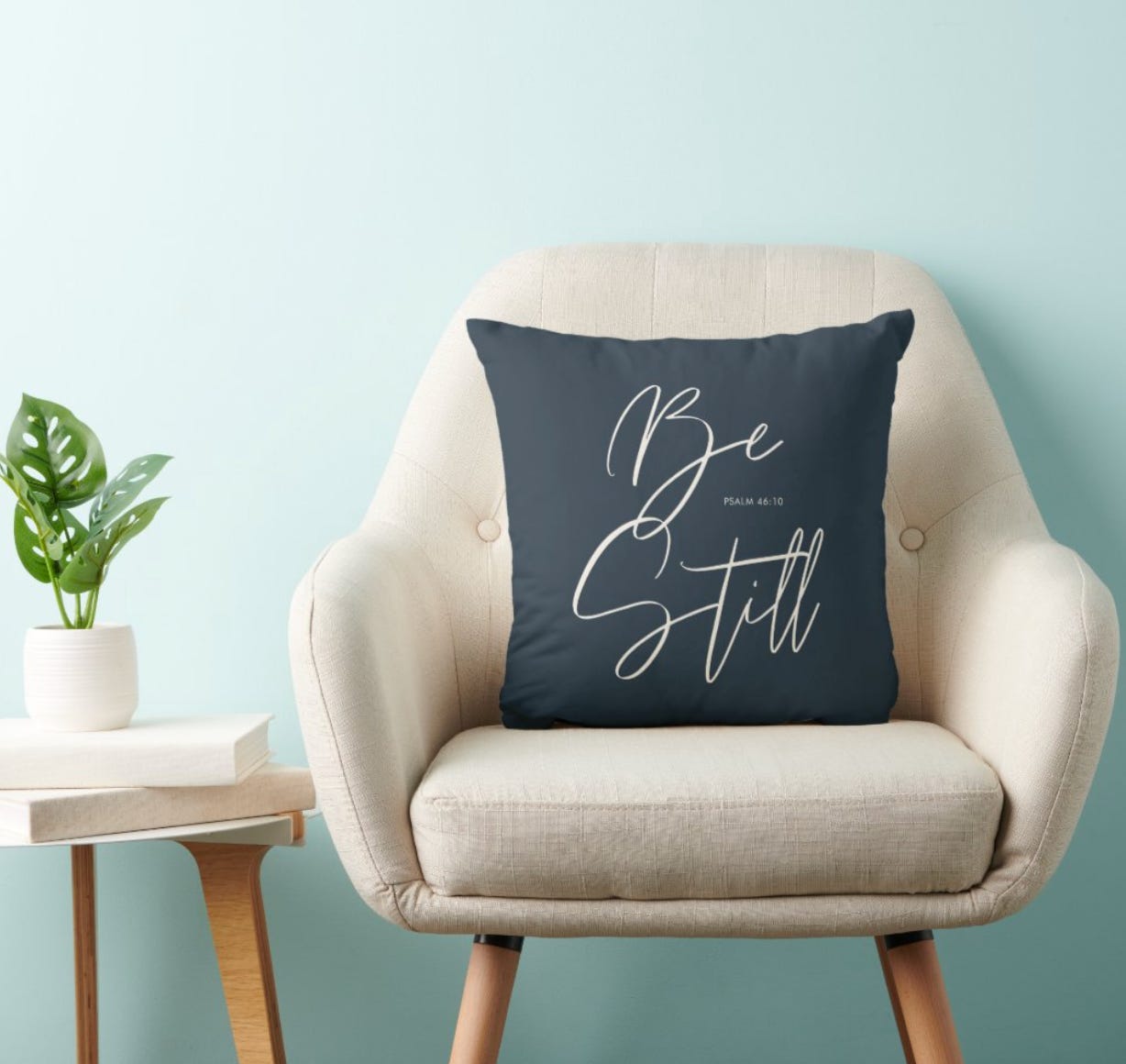
In my faith tradition, we are prone to embroidering certain Bible verses onto throw pillows, creating cute little placards above the kitchen window. Perhaps one of the most common ones is Psalm 46:10: “Be still and know that I am God.” All my life, I have heard this scripture evoked as a mantra for rest and other fuzzy feelings.
And yet, as I am often slow to do with verses I memorized as a child, when you look at the context of this ancient Hebrew song, we see that the writer of this Psalm is in the midst of his own crisis of confidence, his own war.
“Therefore we will not fear, though the earth should change,
though the mountains shake in the heart of the sea,
though its waters roar and foam,
though the mountains tremble with its tumult.” (vs. 2-3, NRSVUE)
The psalmist coaches himself: in the midst of the raging battle, the nations in uproar, he hears God speak above the tumult. And what is interesting to me about this verse today is that God doesn’t say, over the cries of terror and destruction, “Work harder! Don’t take ‘no’ for an answer! Keep striving!” In that moment, Ultimate Reality commands, “Be still and know that I am God.”
Later in the chapter, the psalmist points out that at a single utterance of God’s voice, the earth melts or softens. Put down your sword—or for the artist—close your laptop, set down the brush. Be still and know.
Don’t just toss these words on a loveseat. Put them on a sticky note at your writing desk. Paint them on the wall of your studio. God is commanding us, in the face of the inner and outer wars that we fight, to get very still and listen: let God’s voice soften you.
It reached the point when the only thing standing between Brahms and the finish line was a melody for the finale. He was living in Switzerland at the time.
I imagine him showing up to the piano where he composed with a soul-deep weariness. I see him removing his spectacles and rubbing his eyes, glancing over at the unfinished song-cycle that was likely coming more easily than this God-forsaken symphony. I see him taking a long exhale, putting his quill down, and walking through the front door.
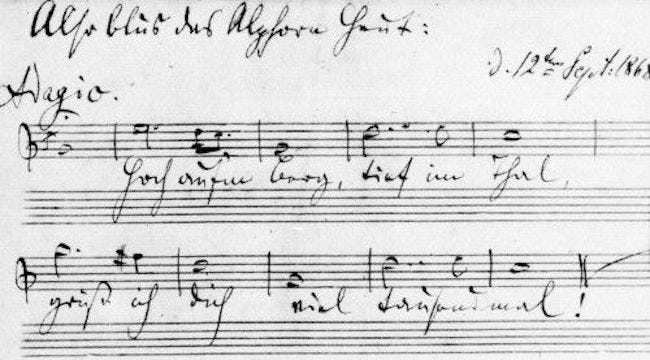
God spoke that day through the alphorn (a Swiss folk instrument) of all things. In a letter he penned on September 12, 1868, to his dear friend Clara Schumann (Robert’s wife), he scribbled down a melody he heard on that walk.4 From across the valley, a voice echoed: a hauntingly heroic and beautiful melody, the key that unlocked his symphony.
Amidst the battle cries of your artist-life, maybe stillness feels impossible. Maybe it sounds like one more task you have to check off your to-do list. But that would be missing the point. The way of creative joy is not paved with more striving but less. The Hebrew word for “be still” in Psalm 46 is translated as loosen or release elsewhere in scripture. One translation5 says,
“Step out of the traffic! Take a long,
loving look at me, your High God,
above politics, above everything.”
The command “be still and know that I am God” is not a pretty platitude—or a self-absorbed command you must strive with all your might to follow—but a booming voice across the battlefield, inviting you to receive the grace that is already yours. And the good news is that it is as simple as taking a walk in the woods, of taking a long, loving look at all God has already done in your life. It is a posture of trust, of deep listening, loosened and open to whatever gifts are waiting just across the alpine valley.

In the stillness of my living room at 5 a.m. recently, I dragged myself onto the couch and opened my laptop. I heard a small voice inviting me once again to try to write this book. When the familiar gymnastics began in my head about my qualifications and my abilities, I decided to stop for a moment and listen. I suddenly felt like I was in the presence of loving-kindness itself. And that’s when I heard the words of Mary Oliver, an Instagram square somehow appearing again in my mind’s eye: “Pay attention. Be astonished. Tell about it.” The floodgates opened, the earth softened, I found my way… through Chapter 1, anyway.
In that moment, the words of the new book made it known that they wanted to come into the world as long-form essays, not as weekly podcasts as they had for my last book. I had this deep intuitive sense that they belonged here on Substack, a change from my usual creative rhythm. I didn’t learn this until I stepped out of the traffic of my life and got still enough to listen.
This is my third installment of this weekly practice, of holding onto the thread of the new book and yet releasing the outcome—of simply paying attention, being astonished, telling about it. And even though I do believe I’ve found the right medium for now, it isn’t easy. In each moment there is a constant need to be still and know, to trust, to get quiet and listen.

If God is an artist, then there are melodies and words and colors waiting in the stillness, gifts from the divine. They are breadcrumbs leading the way out and through the battles we wage, most of our own making and against ourselves.
We are not alone inside our creative efforts, in traversing The Gap. God, a fellow artist, goes with us and closes that distance.
Whether it takes you 22 years or 22 minutes to bring the thing you are making into the world, what would it shift for you to believe that the materials you work with are alive with God’s goodness and grace? That they speak of what should come next, who they are for, how they will be born?
The act of paying attention, being still long enough to stop the incessant striving, this type of listening is essential to life as an artist. Listening is the work. It is, in and of itself, a creative act. Inherent in each moment is an invitation to trust something already singing, to walk out of the studio and into the forest, to let the art speak.
Will you listen?
I wrote a podcast about this piece back in 2021. Give it a listen.
I made the announcement this week on IG.
Read more in this excellent book, “Brahms in Context” by Inga Mai Groote, Edited by Natasha Loges and Katy Hamilton
I absolutely LOVE this format. You pull the reader into a world of wonder. I also greatly benefit from your podcasts for listening while doing tasks around the house or working out at the gym.
Beautiful and encouraging. This quote is so true: “We labor in service to something as nebulous as a feeling we had once while we were walking the dog.” I feel less alone reading your words on the matter of creativity when I feel stuck. I know your next book will be a treasure.