

This essay was originally a podcast. Listen here.
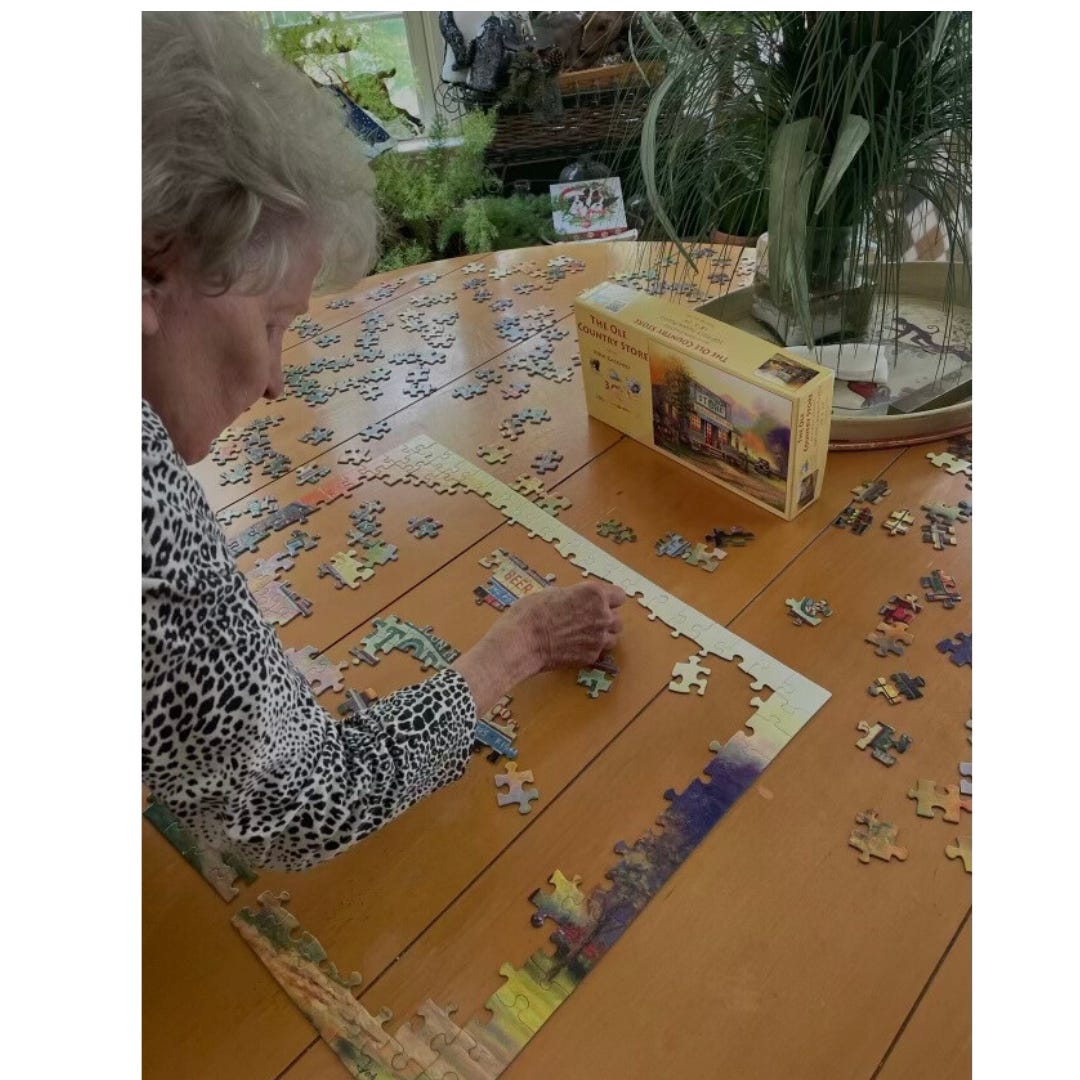
My mother’s mother—we called her Daba—loved nothing more than working large jigsaw puzzles. In college I lived just a few hours away from her and my grandfather. I’d come in through the garage door and find her 5-foot, white-haired frame huddled over the formal dining room table with tea and her glasses, working on a 1500-piece iteration of Van Gogh’s Starry Night or some Christmas shopping scene with 500 different shades of white and red. She’d make this little joy-filled squeal when she placed a piece and joke about getting the scissors out to make a stubborn one fit. We’d work in silence for hours, the two of us.
She modeled for me the meditative and sometimes chaotic process of putting it all together, the need for patience and focus. Sorting “like” colors and straight-edge pieces first, she was methodical, and yet, she loved the thrill of bridging two seemingly disparate sections with that one unassuming piece at the edge of the table.
Watching her, remembering her this way, reminds me not to give up. To believe that the next right piece could be right there, if I’m willing to keep trying.
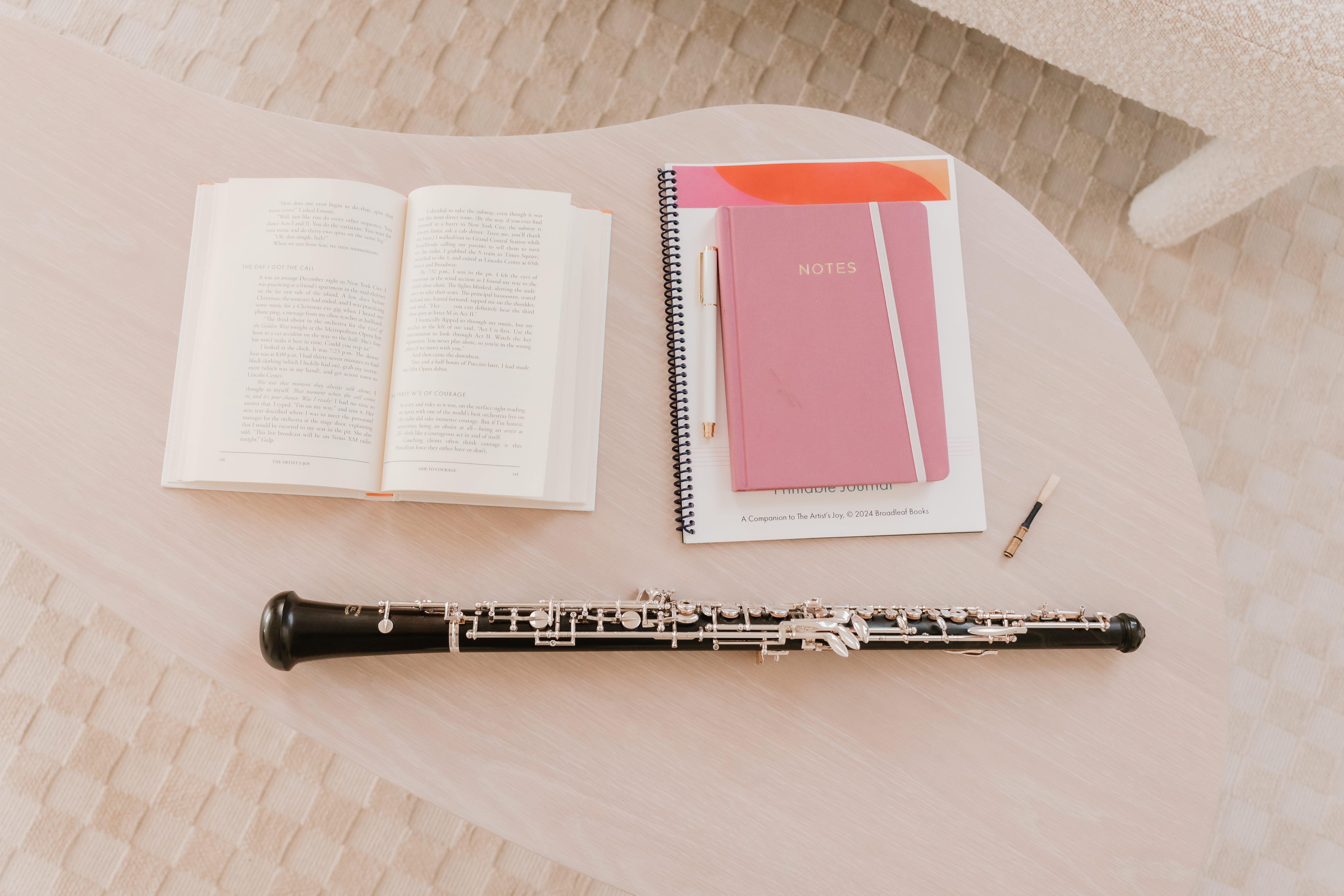
When I was thinking about embracing a more multifaceted, multi-passionate creative career, dreaming of what I might do besides play the oboe, what I might be besides an oboist—the thing I had spent the last 20-plus years of my life doing and being—I had a lot of anxiety.
I had been getting messages from day one about how hard it was to be a classical musician—that if you could do anything else, you should, because if you weren’t 100 percent committed to the craft, then, well, there was really no point. It wasn’t enough to be talented, which, while I thought I had a natural inclination for performing, I didn’t believe I particularly was. Either way, talent would only get you so far, they’d say. And for some reason, I listened.
I have a whole chapter in my book about this—what sociologists call the “generalized other,” this unspecific group of, in reality, one or two people (whom we often don’t even really like or admire) that we let speak into our lives and shape our decision-making. The discouraging messages my THEY broadcast in my mind in those days had all but drowned out my inner artist, muting even God’s voice.
As a result, I worked incredibly hard to live up to some “career trajectory” that I wasn’t even sure I wanted. And then I woke up in my 30s wondering who I could be if I didn’t want to be only this.

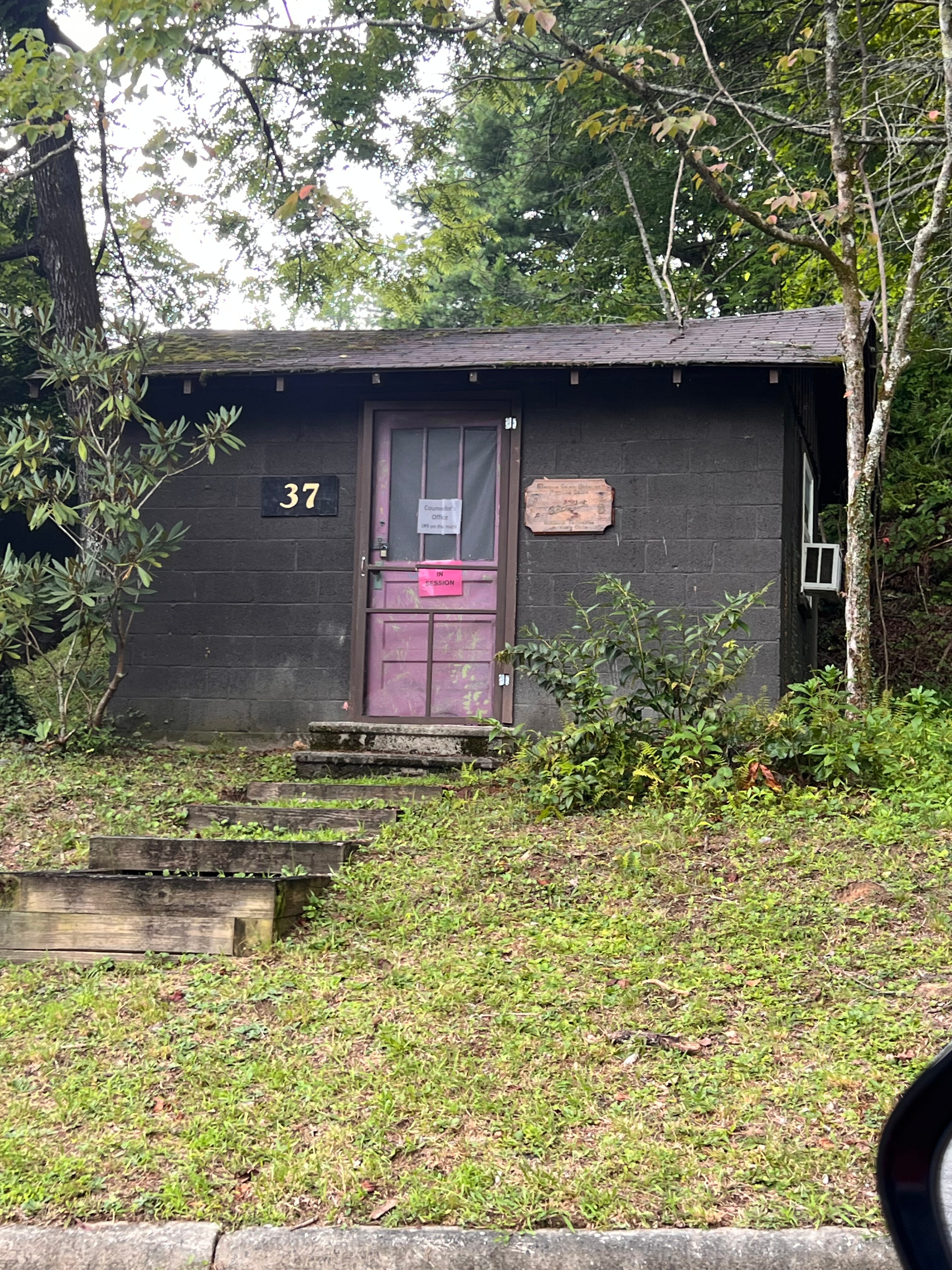
This summer on my book tour, I spoke at a few classical music festivals where students, much like myself 20 years ago, had come for six or eight weeks to train in orchestra and chamber music. It was like regular college and/or boarding school life, only more rustic and miles from air conditioning. Stepping onto campus took me to the center of an old dream. It was the late 90s—memories of practicing and reed making in dusty cabins, Deet and dear friends never far, the masterworks of Strauss and Mahler floating over me, some for the first time, in an open-air theater, my quiet, internal reverberations ringing, What will become of me? Am I good enough? Will I make it?
Returning to music camp gave me the chance to tend to something deep within me. In the low, wet clouds that hovered over the lake, there was some tangled-up part of me I’d left behind. She was fiercely independent, equal parts scared and hopeful, a piece of my inner artist-child waiting for a ride home. She was relieved to know that I hadn’t abandoned her after all, that what became of her was that she was seen and loved, and that we had “made it” in our own way. Everything was alright. Everything made sense—well, most things. I told her that she had been released from the tyranny of “making it” or “being good enough” and that these weren’t the benchmarks we used anymore.
At my talk, which was about rebounding from rejection and failure (ya know, a nice, light topic), a young student in the second or third row raised his hand. He prefaced his question by saying he was a graduate student going into his final year. He said, “We’ve spent years, sometimes even decades, looking to our teachers to tell us everything. How we sound, what we should do next, how we should go about fixing our issues in our playing . . . and, so, my question is . . . How do we make sense of everything when this is over?”
I knew exactly what he meant. Even his tone was familiar. The phrase “make sense of everything” had been a phrase I’d used myself.
You don’t have to be in school or a classical musician to encounter the same quandary.
Have you ever felt shame because of the way your life or creative journey doesn’t make sense, either on paper or otherwise? Because your life isn’t fitting neatly into the parameters “they” constructed for you? Maybe you are on some trajectory, chosen or accidental, and you feel the weight of the rest of your life ahead of you, like that student. Or maybe you got knocked off your trajectory and aren’t sure you are ever going to find your way back. All the planning you’ve done to have the book deal, the baby, the degree, or the job “by now” didn’t pan out, and you are at this murky bend in the road, unable to see your hand in front of your face, unable to make it make sense, with no clue how to chart a new path without “their” instructions.
When I stood in front of those students at that talk, I wanted to tell them about all the times when my life didn’t make sense. I wanted to reassure them that uncertainty or lack of clarity are opportunities for more self-reflection, signs that we’re becoming more truly ourselves and who God1 made us to be. That there is joy in the midst of this free-falling feeling of not knowing where you’ll be or what you’ll be doing in five years.
Instead, I said, “Life is a puzzle,” thinking of my Daba, using a metaphor that felt like a gift directly from her. I told them that when we are growing up, each formative experience gives us a piece of our puzzle. We don’t even get a box with the picture on the front, but somehow we’re supposed to use these disparate pieces to create a beautiful image. And it isn’t just our education that gives us new pieces. It’s life at home, that first friendship when you feel known, that feeling of joy when you make the first sculpture or play the whole piece through for the first time. It’s the painful realization that the dream you had for so long won’t be coming true in the way you’d hoped it would. You get puzzle pieces each time you grow.
And when it’s time to leave school, when it's time to leave mentors behind and take the wheel of our own lives, we are tasked with putting this puzzle together. And it can be really disorienting—because not every piece fits anymore. Some pieces we’ve been carrying around need to be let go of. And there’s no use looking at the image others are making, because ours is unique.
Making sense of your life means never abandoning that puzzle, always trusting yourself enough to keep on trying.
Realizing I could be more than an oboist was the piece that helped me connect large swaths of puzzle from the right side to the left. I had to take what my mentors and teachers taught me and hold it up to the light after my schooling was over and decide if it was the piece I was looking for in the current section I was working on.
As much as we’d like it to be, life isn’t a straight trajectory—it is a complex and beautiful work of art that we are piecing together as we go. Rilke’s letter to a young poet expresses this perfectly: “Be patient with all that remains unsolved in your heart and try to love the questions themselves, like locked rooms and like books that are now written in a very foreign tongue. Live the questions.2”
What if you could trust yourself? What if there is sorrow, yes, but also joy in watching a corner come together? What if this process continues well after graduate school? There will be disappointments and seasons where you look up and realize that you are attempting to jam a piece into a place it does not fit. And what if there is something new you may be learning today that connects that random, jagged edge in a different color to the whole picture?
We are creating a life. It isn’t linear or even logical.

With that young man’s question, I realized how much we all, artist or not, are living the questions, moving the pieces of our puzzle around and longing for it to make sense, impatient for all that remains unsolved. With my answer, I started seeing my role as a coach as a companion at an artist’s puzzle table.
And listen, the messy divorce or inexplicable loss, the injury or terrible mistakes, the trauma that burned through a perfectly good picture of a life you were building—there are some things that may never make sense on this side of heaven. There may be parts of your story whose red hot center you cannot even touch, much less put together into a cohesive narrative. But look to the right and left of those experiences on the puzzle table, and see how you persevered, how you’ve grown, how you are still here, working on putting it all together. Believe there is something worth seeing in the chaos and dissonance of all these incongruous pieces. Keep going.
I won’t share the details, but Daba’s life puzzle was sometimes not simple or straightforward to put together. When you live to be 92, you collect a lot of pieces. We never stop growing, so there is no ta-da moment of completion when our time is up and the picture is done. She didn’t stand in the dining room doing what she loved much in the last few years of her life because of a long illness.
We lost her last year.
And yet, I’m so grateful that she taught me to love each piece of the puzzle, real and metaphorical. She enjoyed the process of putting it all together, of living, more than almost anyone I know. Her life meant something; she was loved.
I carried the question from that student in my heart for the rest of my tour, and it is following me into the fall. “How do we make sense of it all?” Daba would say to start by putting all the flat-edged pieces together and then group the rest by color. One piece at a time, that’s how.
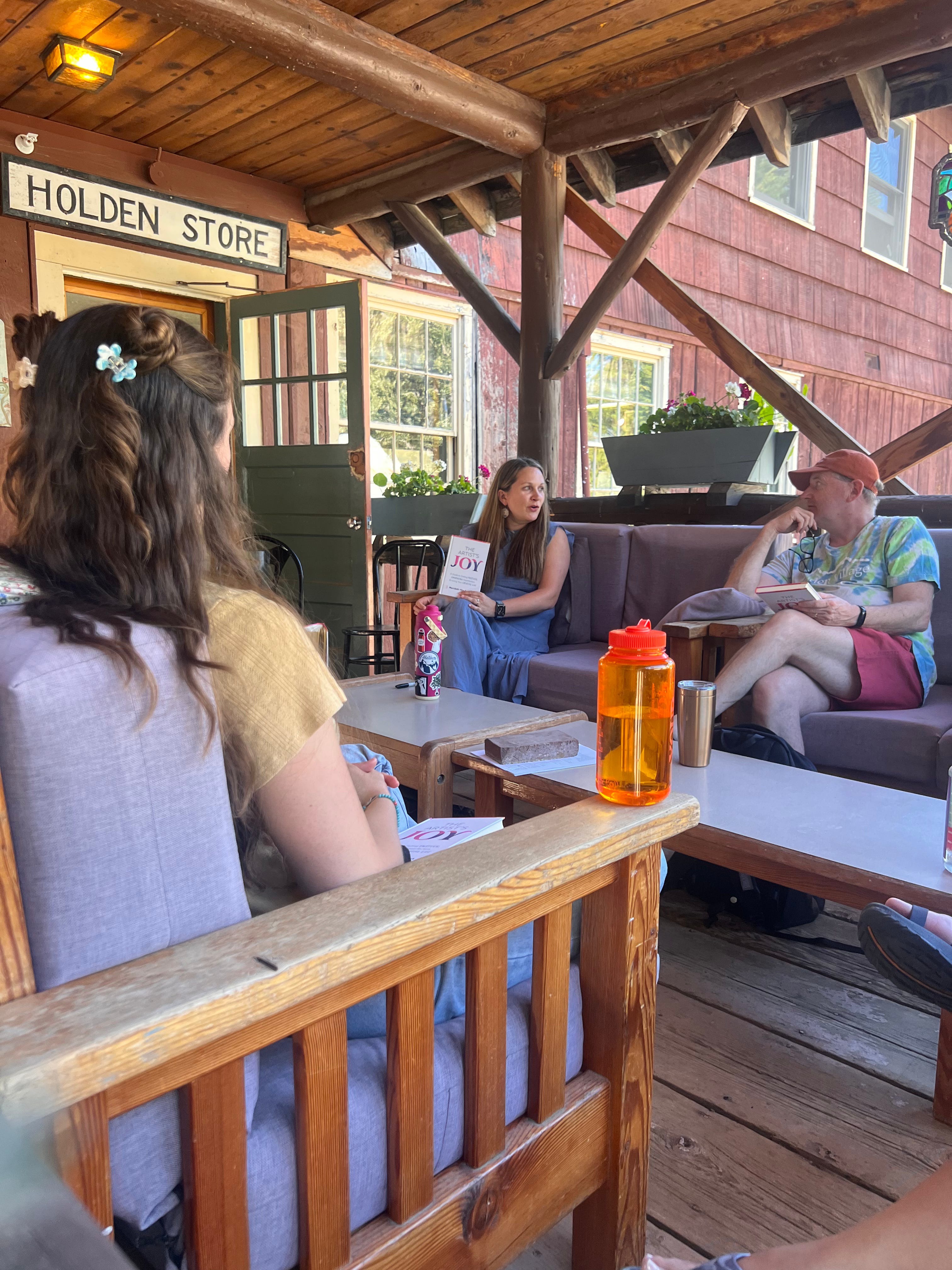
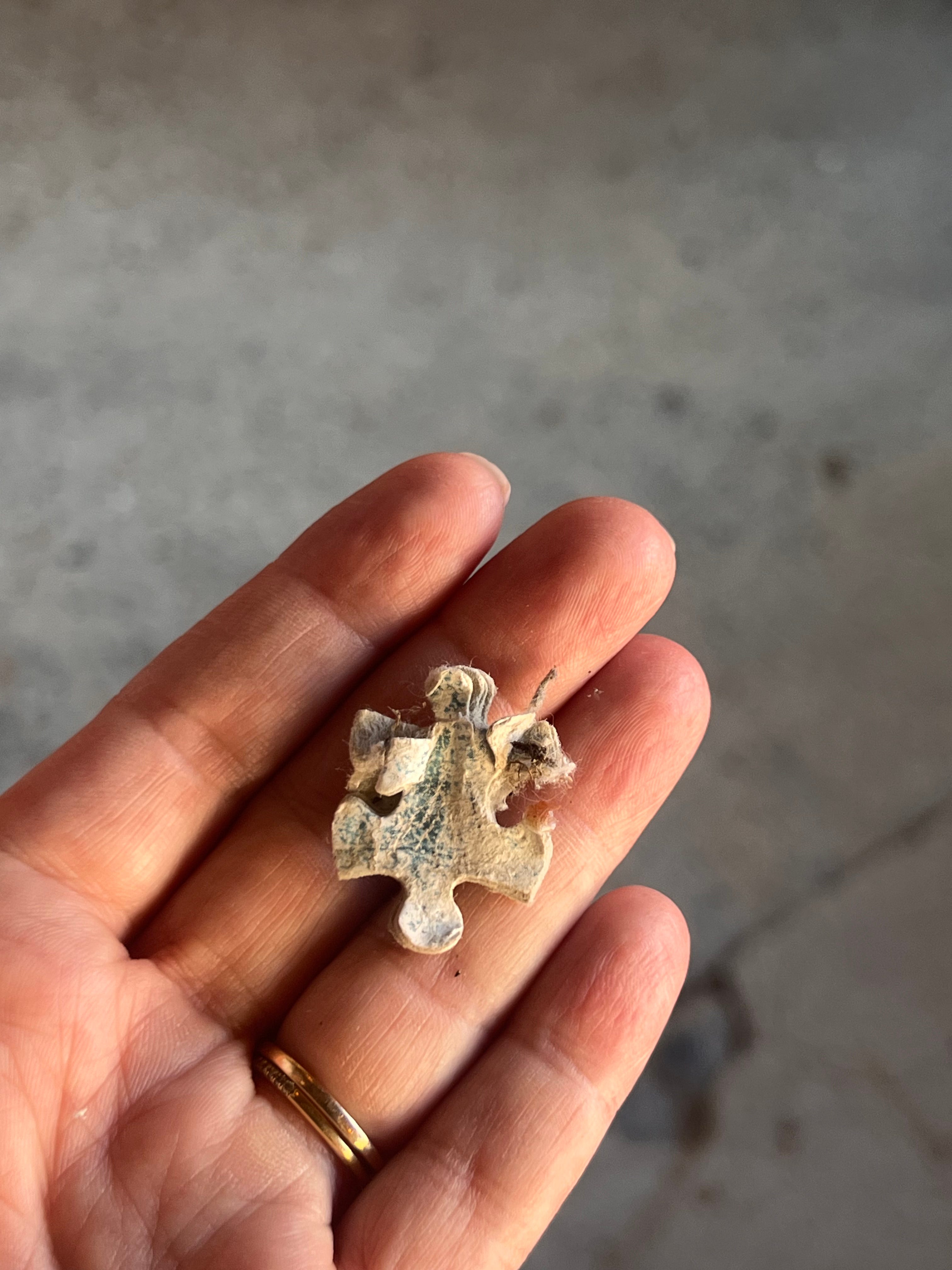
At one of my last summer book tour events, I was doing a reading on the porch of a bookstore in rural Washington state, swatting flies as we overlooked a cascade mountain range in an old copper village turned retreat center. After the reading, as we packed up my book banner and started off the porch, I dropped my pen. And as I leaned down to grab it, you will never guess what I found in the crack between two slabs of concrete. It was a warped and dusty puzzle piece, likely long searched for by someone enjoying this porch before us, the image on it completely faded and worn from years in the elements.
I felt my chest warm. It was Daba, it was God, encouraging me, reminding me I am not alone.
And so I am here to tell you that you aren’t alone either. How do you make sense of your life? The answer for me means first deciding to love the puzzle, the process of it. It means doing Daba’s victory squeal when I make a connection and vowing to never give up, to never stop growing. To pick up the pieces that my growth earns me, even when it’s uncomfortable or downright painful. To accept the parts of the whole we are given, even when it means going back or kneeling in the dirt, even when we do not understand it or see how it fits into the picture of our lives we thought was emerging. It means giving ourselves the grace to do the gentle work of becoming, different than we imagined we’d be maybe, but true and full and right on time.
This is the work of “making sense,” the life-long adventure of fitting together the puzzle of who we are and what we’re meant to do. It may take longer than you’d hoped, but if—when—you’re willing to look down at the complex picture coming into view, you’ll notice it: each piece is hemmed in by Love itself.
Wondering where I stand faith-wise? Here’s an excerpt from my book that explores how I approach (what I call) the “Higher Power Elephant” in creative recovery work. Click here to check out our “What We Believe” page to learn more.
https://www.amazon.com/Letters-Young-Rainer-Maria-Rilke/dp/0393310396
I've always loved Rilke's advice to "Live the questions." So so good. Thanks for sharing this!