


In the movie Garden State, Zach Braff’s character says something about growing up that has always stuck with me. He says: “You know that point in your life when you realize that the house you grew up in isn’t really your home anymore… All of a sudden, even though you have some place to put your stuff, that idea of home is gone… You will never have that feeling again until you create a new idea of home for yourself—for your kids, for the family you start. It’s like a cycle or something. Maybe that’s all family really is: a group of people that miss the same imaginary place.”
I’ve been thinking about that line a lot lately—about family, the cycles of life, and what it means to miss a place that exists mostly in our memories.
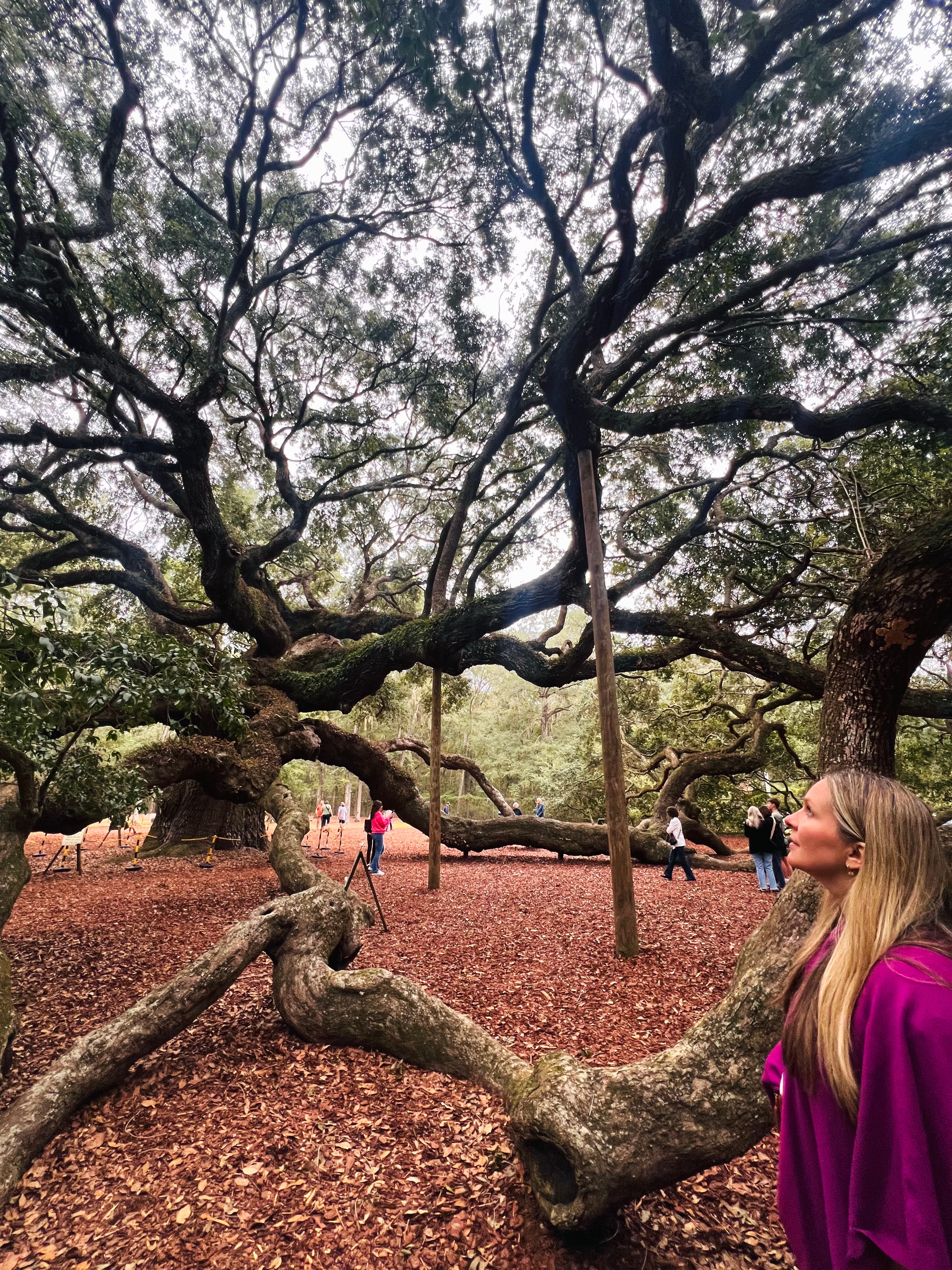
Somehow my family has become the kind of people who drive half an hour out of the way to see a tree. The Angel Oak is off a rural two-lane highway in John’s Island, SC, not far from where our family has been vacationing for the last decade. If you’ve spent any time in or around Charleston, you’ve likely seen images of the Angel Oak. It is a 67-ish-foot-tall, 28-foot-circumference Southern Live Oak. At over 400 years old, it is often named as one of the oldest trees east of the Mississippi. Its canopy covers more than 17,000 square feet, and being there with my family this past weekend made me feel human and alive.
We had left the peak fall foliage in Michigan for the hot, humid air of my home state for the wedding of my cousin’s daughter on Kiawah Island. My dad has three older sisters, and growing up, the Hite kids were always the youngest of all the cousins. I was a flower girl in my cousin Patsy’s wedding about 30-odd years ago, and now her daughter, Abby, was getting married. She invited my husband Edwin to officiate and me to play the oboe, and we wouldn’t miss it.
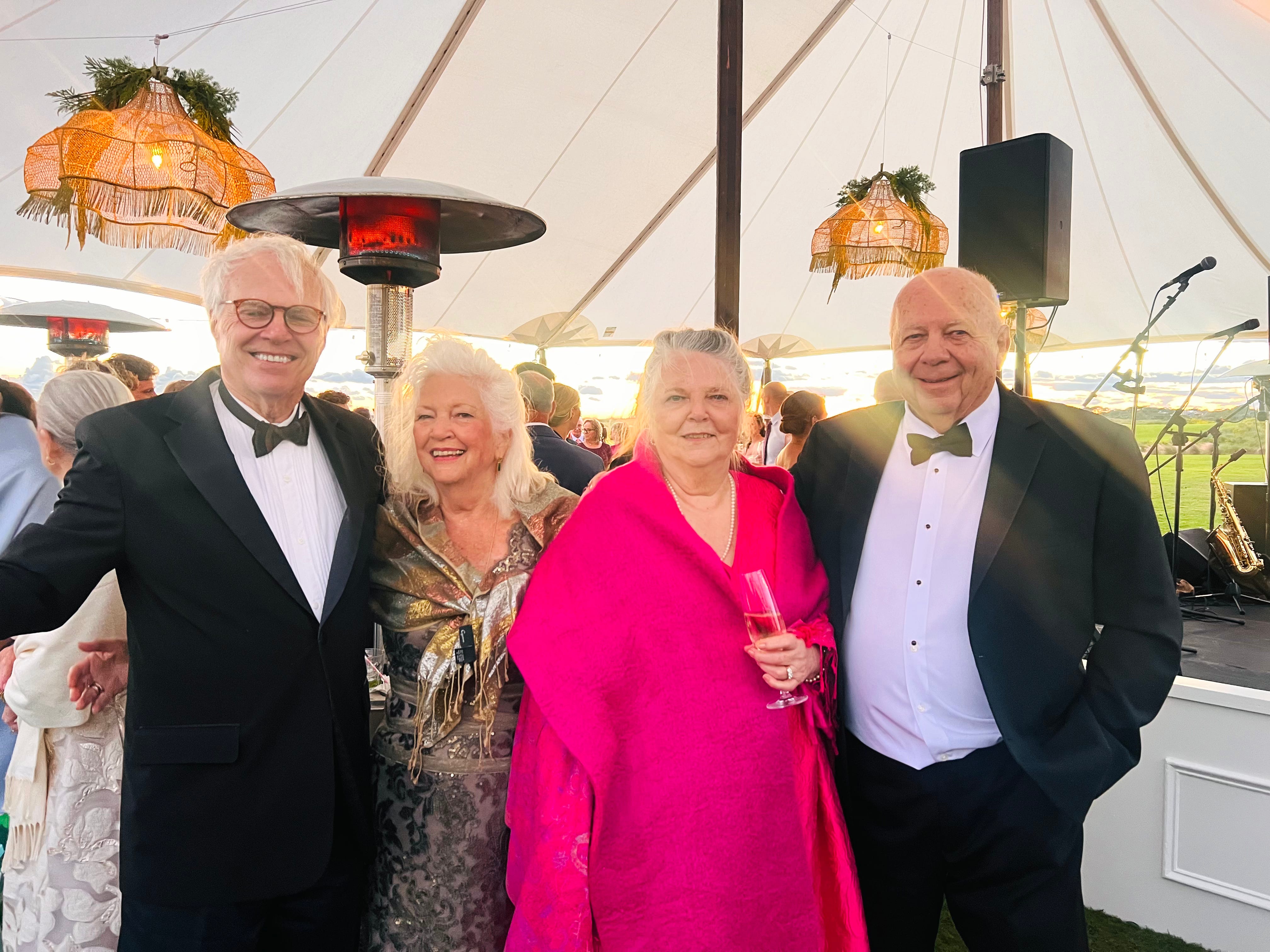
What can I say about the imaginary place that this specific family misses? This home that is gone, as the cycle continues, as the children grow? What can I say about these people that raised me?
When I saw my uncle Edgar this weekend, for the first time in a very long time, his walk was far less determined and steady; there were new lines on my face, my own children stood before him now for (maybe) the first time, and yet, we were still us. His eyes still sparkled. I closed mine and let my aunts’ southern lilt and genteel softness wash over me; my grandmother, their mother, Mimi, was there in the sound of their voices and in their hairlines. On the way back to the car after the welcome party, I felt teary, but not completely with sadness, per se.
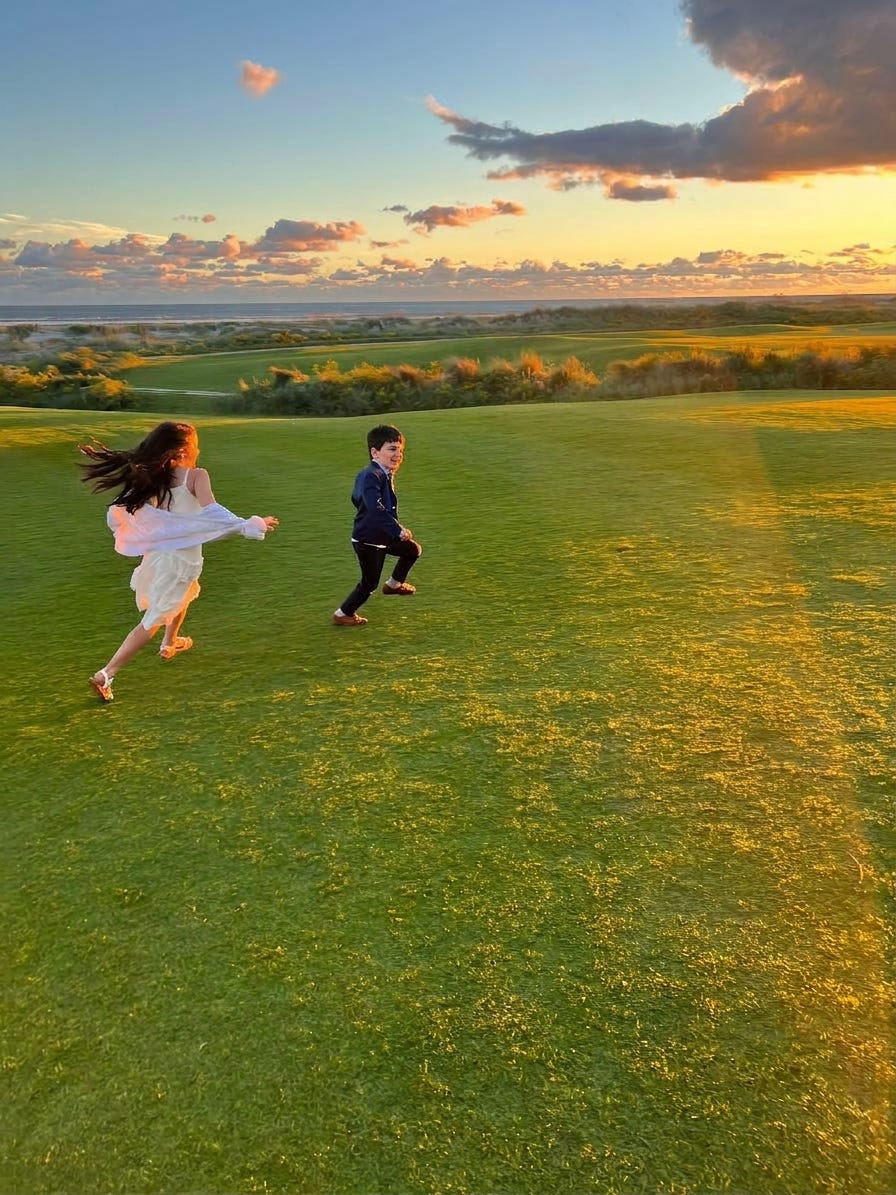
Perhaps this is the most human thing there is: a sudden, intense rush of joy and grief at the passage of time, for the aging and the aged. The feeling of the children circling our legs, the way I felt three and 43 at the same time, all as the sun sank into a marsh that was brimming with life.
When I say art is an open door to divine love, I mean art on a museum wall or in a concert hall, but also the trees and critters on this God’s spinning opus. There are the works of human hands, and there is Mother Nature; both are used by God to call us to our truer home, including but beyond our nuclear families, to a place that’s not imaginary, but more real than any love we’ve known yet.
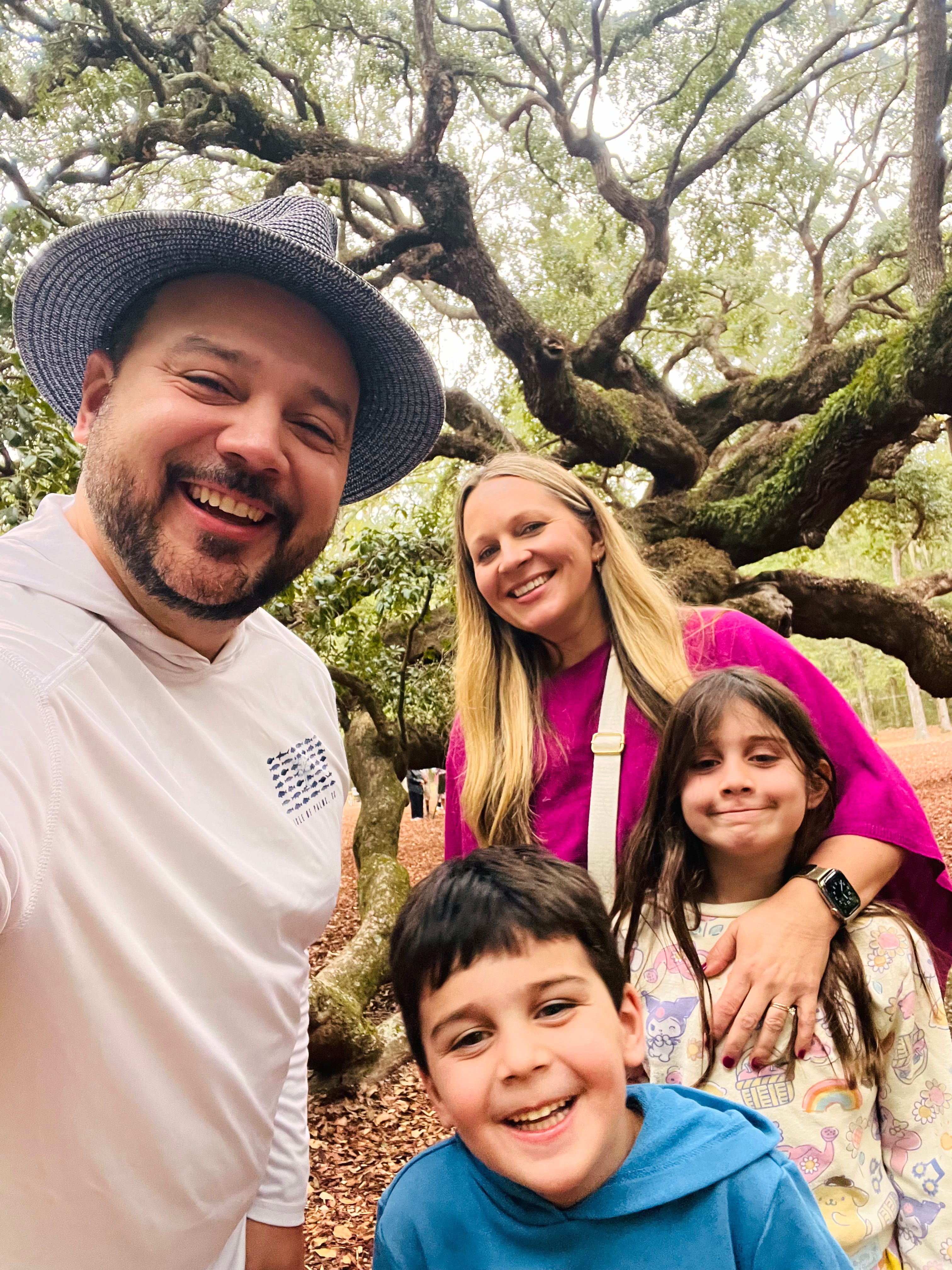
Which brings me back to the Angel Oak.
There are strict rules against leaning on, climbing, or sitting on any part of the old tree because many of its limbs are hollow. I read on one of the placards that southern live oaks compartmentalize decay. As the internal decay happens, the tree seals off the hollow sections to protect the surrounding living tissue. A live oak can remain remarkably strong and structurally sound even with a hollowed-out center because the newer outer wood rings provide most of its support.
Still holding the unique mixture of joy and grief from the welcome party, I found myself the next day standing under one of the most magical creations I had ever seen. A tree that was here before the European colonizers were, before my ancestors were, a tree, I read on a placard, that functioned as a gathering place for the civil rights movement in the Deep South, giving shade and hope to those fighting for justice—as I stood among her strength and grace, holding the weight of time’s passing, I sensed an invitation to accept my own growth process and my own decay, to see them both as beautiful.
The tallest limbs of Angel Oak are supported by beams and sectioned off with a rope and chain because they are hollow. The new growth continues outward as the center dies. This paradox—a hollow core with strong ongoing growth—became a powerful metaphor for family, for creating, for life. Growth always requires a hollowing, a pouring out, a surrender. When we lose the irreplaceable cores of our family trees, the message of the Angel Oak reminds me to trust that God is doing a new thing despite the loss.
This is the spirit of kenosis—the Greek word Paul uses in Philippians 2 when he writes: “Let the same mind be in you that was in Christ Jesus, who, though he was in the form of God, did not regard equality with God as something to be exploited, but emptied himself, taking the form of a servant.”
At the very center of this ancient tree, strong and mighty in its sprawling canopy, is an emptiness, a hollow decay. But this does not stop its growth; it isn’t a structural failure—it’s a kind of holy opening. Christ’s kenosis, his self-emptying, made space for divine love to pour into human history. I realized more fully this weekend that, for us, emptying our old ideas of home and the constant need for control makes space for the new growth God is bringing.
Our crow’s feet, our walking sticks, our children’s too-small socks, the prickly grays in a beard—these are not simply signs of all we’ve lost. They are promises that our emptying, our healing, our journey toward a truer home, is happening in these miracle cycles of life.
The Angel Oak does not collapse from its hollowness. In fact, its ability to compartmentalize decay as it grows outward is a reminder that our empty places are exactly where God’s love and beauty are poured in; these are where true strength begins.
Our homes are not lost. The imaginary places that we miss are proof of our longing for another world. Decay and growth, then, are interlaced like two branches growing towards the light. Like all beautiful things, they are being made perfect in God’s time.
What if these open spaces we are called to release into God’s hands are filled with grace for the journey home?
The Gallery
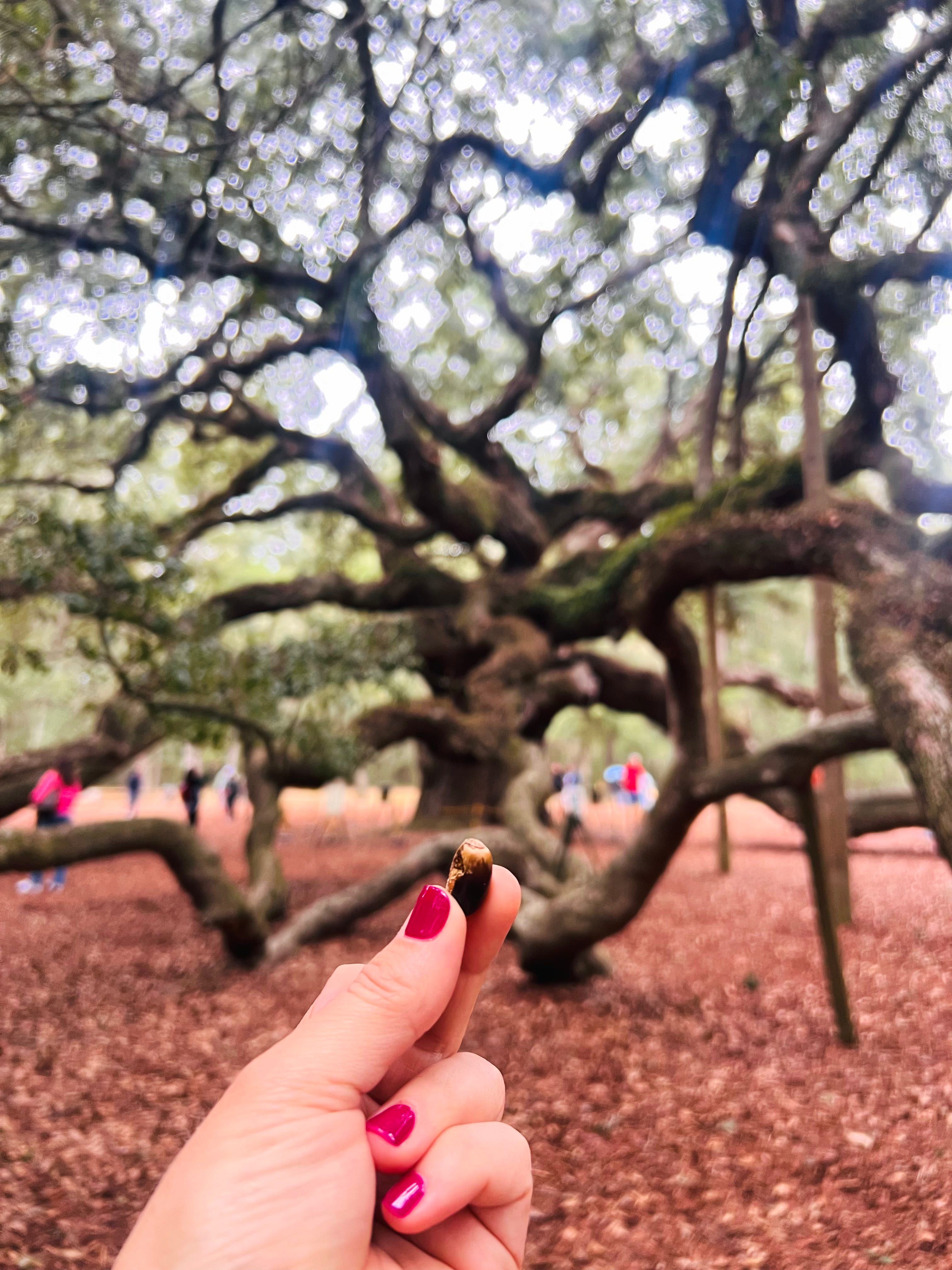
For today’s gallery, the segment of the show where I share about a work of art that stopped me in my tracks, I couldn’t help but get micro and call attention to the mighty acorn. Having grown up in the Upstate of South Carolina, I’ve never been to the Low Country in October before (at least that I can remember), and friends, with all the Live Oak trees on John’s Island, I was not prepared for the amount of acorns that were constantly falling from the sky. You know that satisfying crunch when you get a really dry one between your shoe and the pavement? I enjoyed the percussive quality to the walks, and my daughter collected dozens of tiny acorns little stems to use as hats for little dolls she was making, but also, I was not ready for these sometimes rather large acorns falling into my hair and hitting parked cars with a loud bang. They were in the bottom of the resort's pool; there were prey for kamikaze squirrels on the hunt; the acorns were taking over the entire island.
And it struck me as I was walking under the Angel Oak that that tree came from one tiny little seed. Four hundred years ago, a single acorn fell into the humid soil of John’s Island. To the naked eye, it was just a hard-shelled piece of squirrel food—insignificant, easily forgotten or stomped underfoot. But locked inside that small shell was the blueprint for a 17,000-square-foot canopy, dragon-tail limbs that would rest on the earth, and a sanctuary of shade that would shelter generations through centuries of human history.
But what I am taking away from witnessing the acorn apocalypse is the reminder that this powerful seed, before it became a Southern Live Oak, had to do something radical: it had to let go of being an acorn. It had to crack open, surrender its shell, and dissolve into the darkness of the earth.
The mighty acorn, this work of art, reminded me: that whatever small, unglamorous, or empty space we are creating in today—whether it feels like a tiny nothing of a seed or a hollowed-out center at your core—remember that God does not waste a thing. Beauty often begins in the dark, with being broken open.
Liturgy for the Living
For today’s liturgy of the living, I invite you to be the kind of person who goes out of your way to experience beauty. What do you usually rush past? What natural wonders are nearby that you could make time for this week? (Reminder: I grew up in SC and have been coming to the Low Country regularly for years and never made time to see Angel Oak until this past weekend, and I’m so glad I did.) Invite God to speak through the beauty before you; listen in prayer to what you are supposed to take with you from that time.
A little benediction before you go:
May you make peace with the gray hairs and the children who grow way too fast.
May you see growth and decay as one process, intricately connected and conducted by an Artist God.
May you give thanks for the imaginary places you miss, have the courage to pour yourself out for those God loves, trusting that all that is hollow and empty and missing in you will be filled and returned to you in time.
Rest under the canopy of the Ancient of Days, trusting the one who brings all growth loves you, holds you, brings you home.
Tell me in the comments:
What beautiful trees have you seen in our world? While researching the episode, I came across a list of trees around the world. Have you seen some of them? What did you learn from their beauty? Tell me in the comments!


